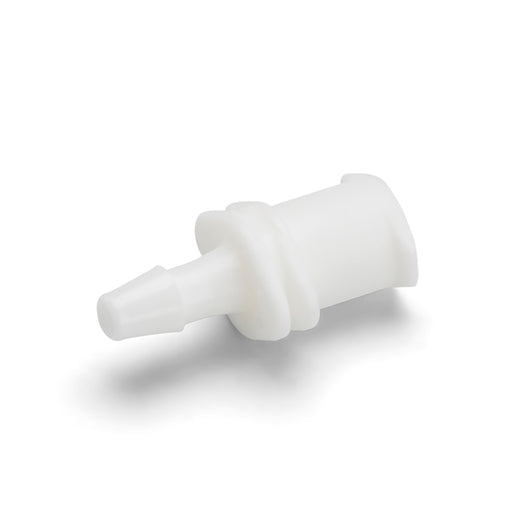
The reorder for your usual primary IV set comes back backordered and the distributor offers an alternate. It has a different drop factor, or it is a gravity set for a pumped line. This guide covers what each spec on an IV administration set means, so the buyer can approve an equivalent in one email. Set selection follows the facility's protocol and the pump manufacturer's compatibility list. Keystone confirms the spec; the clinical team owns the choice.
Primary, secondary, and extension sets
A primary set runs from the container to the patient: spike, drip chamber, tubing, roller clamp, one to three injection ports, and a luer lock at the distal end. Keystone's stocked primary sets run 79 to 113 inches on the B. Braun SafeDay and Caresite lines, 103 inches on the ICU Medical PlumSet 1468728, and 104 inches on the BD Alaris SmartSite gravity set 42434E.
A secondary set, the piggyback, is short. The B. Braun V1921 is 40 inches and connects a second container to the upper port of the primary set. An extension set adds length, a needle-free port, or a filter between the primary set and the catheter; Keystone stocks B. Braun extension sets from 6 to 30 inches in small and standard bore.
The CDC guideline on intravascular catheter infections, written with the Infusion Nurses Society and 14 other organizations, sets the replacement cadence: continuously used sets, including secondary sets and add-on devices, no more often than every 96 hours but at least every 7 days; tubing for blood, blood products, or fat emulsions within 24 hours; propofol tubing every 6 or 12 hours per the manufacturer. A lipid line can consume seven sets in the time a crystalloid line consumes one. Build par levels on that.
Drop factor and the drip-rate arithmetic
The drop factor is the number of drops that make one milliliter, printed on the package. Macro drip sets deliver 10, 15, or 20 drops per mL. Micro drip sets deliver 60 drops per mL for small, controlled volumes. For a gravity infusion, drops per minute = (volume in mL divided by time in minutes) x drop factor. The same order, 1,000 mL over 6 hours, counts differently on every set:
| Drop factor | Drops per minute | Count per 15 seconds |
|---|---|---|
| 10 gtt/mL | 28 | 7 |
| 15 gtt/mL | 42 | 10 to 11 |
| 20 gtt/mL | 56 | 14 |
| 60 gtt/mL | 167 | 42 |
On a 60 gtt/mL set, drops per minute equals mL per hour. A substitute with a different drop factor changes the number every nurse counts on a gravity line, so treat it as a hard spec. B. Braun sets 352601, 352636, 352640, and V1921 in Keystone stock are all 15 gtt/mL. On a pump set the pump controls the rate and the drop factor serves the gravity fallback.
Gravity sets and pump sets are not interchangeable
A gravity set meters flow with the roller clamp and the drop count. A pump set is built around one manufacturer's mechanism. BD states that Alaris Pump module sets were developed for that module, and that any other set may cause improper operation, inaccurate delivery, or other hazard. The Alaris set carries a safety clamp fitment that closes when the set leaves the pump, which prevents free flow.
ICU Medical Plum sets use a cassette instead of a straight pumping segment, with a flow regulator that engages when the pump door opens, backpriming, and a gravity mode for fallback. A Plum cassette does not load into an Alaris module, an Alaris set does not load into a Plum 360, and a gravity set has neither a pumping segment nor a cassette.
Keystone stocks all three families: B. Braun SafeDay gravity and pump set 352641, ICU Medical PlumSet 1468728, and BD Alaris SmartSite pump burette set 2441-0007. For a pump set equivalent, name the pump make and model. The manufacturer's compatibility list decides, not the catalog description.
Needle-free connectors and scrubbing the hub
The CDC guideline directs facilities to use a needleless system to access IV tubing, to scrub the access port with an appropriate antiseptic, listing chlorhexidine, povidone iodine, an iodophor, or 70% alcohol, and to access the port only with sterile devices. It also directs facilities to keep all system components compatible to minimize leaks, and to change needleless connectors no more often than every 72 hours or per the manufacturer. BD's instruction for the SmartSite valve is to swab the top with 70% alcohol before each access.
For purchasing, the connector family is the spec. SmartSite is BD, Clave is ICU Medical, Ultrasite and Caresite are B. Braun, Interlink is Baxter. Flushing protocols and disinfection caps are written around the connector on the line, so a change in family is a nursing decision before it is a purchasing one. Keystone stocks the BD SmartSite valve 2000E, B. Braun Ultrasite positive displacement connector 415110, ICU Medical Spiros closed male connector CH2000, and Baxter Interlink male luer lock adapter 2N3399.
Filters, DEHP-free material, and dispensing pins
ASPEN recommends a 1.2 micron in-line filter for total nutrient admixtures, dextrose and amino acid admixtures, and lipid injectable emulsions, placed as close to the catheter hub as possible for total nutrient admixtures. The 0.2 micron filter appears on sets and extension sets for non-lipid fluids. Keystone stocks the B. Braun SafeDay primary set 352643 and Filterflow extension set 354221, both 0.2 micron, the B. Braun extension set 473994 at 1.2 micron, and the BD pump blood set 2477-0007 with a 180 micron filter. The micron rating on a substitute must match the original exactly. A 0.2 micron set is not an equivalent for a 1.2 micron lipid line.
DEHP is the phthalate most commonly used to soften PVC in medical products. B. Braun notes that DEHP leaches from PVC, that drugs such as Taxol increase leaching, and that neonates receive significant exposure. B. Braun launched Caresafe sets not made with DEHP or PVC in 2021, BD lists DEHP-free Alaris sets, and ICU Medical offers a full portfolio of non-DEHP Plum sets. If the SKU you buy today is DEHP-free, the equivalent must be too.
Pharmacies that draw repeatedly from multi-dose vials use dispensing pins instead of needle sticks through the stopper. Keystone stocks the B. Braun Mini-Spike dispensing pin 412026, the BD Interlink vial access cannula 303367, and the ICU Medical ChemoClave vial spike CH-70S-10.
The spec checklist to send for an equivalent
Send this with your current manufacturer number; the sales department returns a matched equivalent with lead time the same business day.
- Set type: primary, secondary, extension, or burette.
- Gravity or pump; for pump sets, the pump make and model.
- Drop factor in gtt/mL.
- Ports: count, position, and connector family.
- Filter: none, 0.2 micron, 1.2 micron, or blood filter rating.
- Tubing length in inches; small or standard bore.
- Spike, vented or non-vented; distal connector, luer lock or spin lock.
- Back check valve, clamps, and free-flow protection.
- Material: DEHP-free, PVC-free, not made with natural rubber latex.
- Case quantity and monthly usage.
What to do next
Browse the stocked B. Braun, BD, ICU Medical, and Baxter lines on the IV and infusion supplies page. In-stock items ship from Edina, Minnesota in 1 to 3 business days, quotes go out the same business day, Net 30 is available for approved accounts, and backordered SKUs get a verified equivalent sourced through a 490-plus distributor network. Send your set list through the fast quote form or contact the sales department with the checklist above.
Sources
- https://www.cdc.gov/infectioncontrol/pdf/guidelines/bsi-guidelines-H.pdf
- https://nutritioncare.org/wp-content/uploads/2025/01/IV-Filters-For-PN_small.pdf
- https://www.nursetogether.com/calculate-iv-drip-rate-drop-factor-formula/
- https://www.bd.com/content/dam/bd-assets/na/medication-management-solutions/documents/brochure/IF_Alaris-Pump-Module_FQ_EN.pdf
- https://www.icumed.com/products/infusion-therapy/infusion-pumps-and-software/plum-large-volume-pumps/plum-dedicated-sets/
- https://www.bbraunusa.com/en/about-us/responsibility/patient-and-provider-safety/diethylhexyl-phthalate-and-polyvinyl-chloride.html